

Stamping Line Tilter – Automatic Workpiece Turning Station for Sheet Metal Production Processes
Share to : 


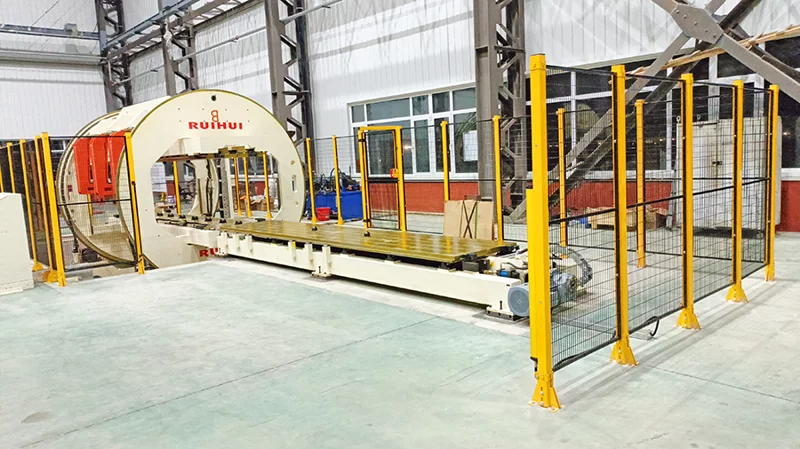
Anyone working in stamping will recall that, alongside the main equipment like presses, feeders, and manipulators, there is a category of auxiliary equipment that may not look prominent but is indispensable at critical moments—and the tilter is one of them. Many people hear "tilter" and assume it simply flips a single stamped part over. That is not the case here. The stamping line tilter we are talking about turns an entire stack of sheets or stamped parts by 90 or 180 degrees—a stack weighing anywhere from several hundred kilograms to several tons, far too heavy for manual handling. This is a standalone process step on the production line, not something performed inside the press.
Why does a stamping line need such a turning operation? After coil blanking, the sheets are stacked, and during handling, they often need to be turned over: some sheets have a surface coating that needs to face a specific direction before entering the next process; some stamped parts must be flipped to inspect the underside for quality; some stacks need to be upright for easier transport and storage; and in other cases, the destacker requires the stack to be oriented in a particular direction for proper pick‑up. In all these scenarios, the entire stack must be turned, and with a stack weighing hundreds of kilograms to several tonnes, manual effort is out of the question—only a tilter can do the job.
Before tilters were available, how did factories handle flipping entire stacks? Most used an overhead crane to lift the stack, with workers standing by to guide and pull it slowly during the turn. This task was both slow and hazardous—the stack's center of gravity was unstable, and the load could easily tilt unevenly; a slip or fall could cause a major accident. Moreover, flipping one stack occupied the crane for a long time, delaying other lifting operations. Some factories chose to avoid flipping altogether, preferring to add extra handling steps rather than take the risk.
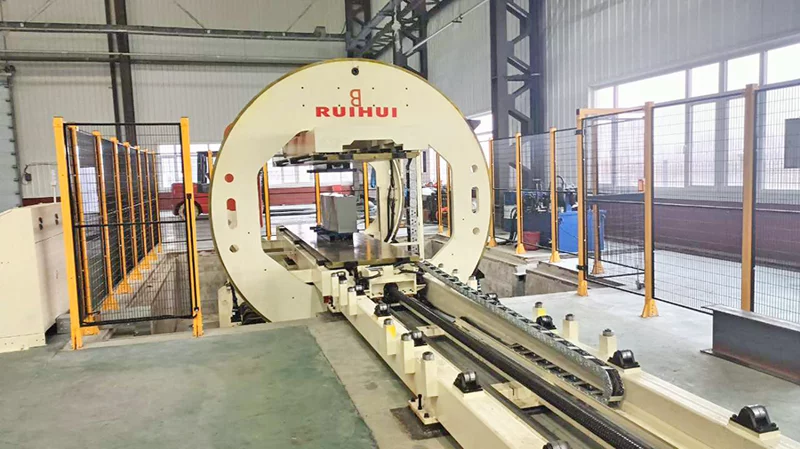
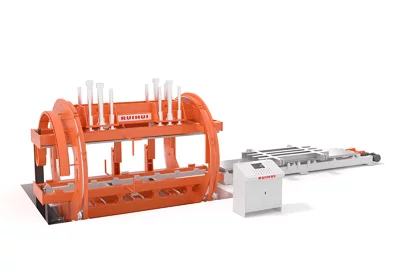
The principle of a stamping line tilter is straightforward: the entire stack is placed into a tilting frame, which clamps it securely. A drive mechanism then rotates the frame together with the stack by 90 or 180 degrees. Once in position, the frame releases, and the stack is now safely reoriented. The entire process is automated, requiring no manual pushing or pulling, and both safety and efficiency are on a completely different level from manual methods.
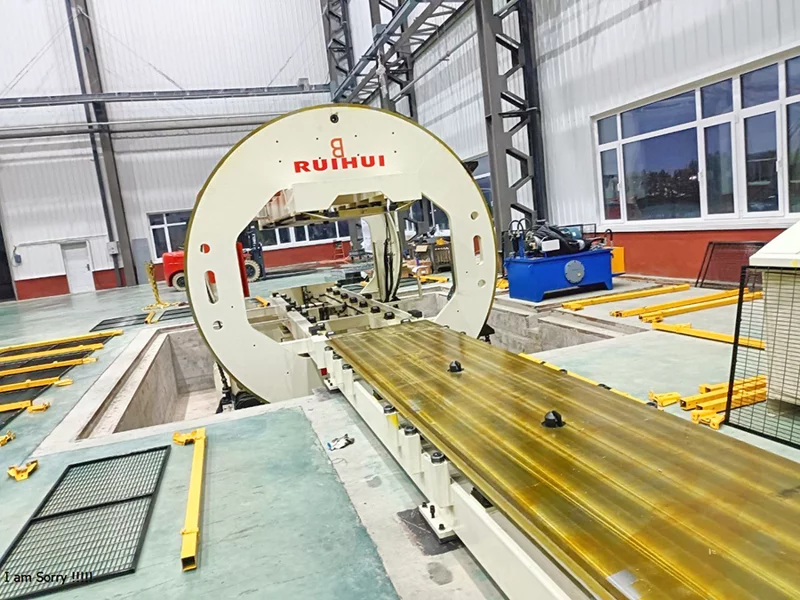
When selecting and using a tilter, several key points must be considered. First is load capacity—this is fundamental. You must know the weight of each stack, and the tilter's capacity must be sufficient, with an adequate safety margin. Second is the clamping method. If the stack is not firmly clamped during turning, individual sheets may slip relative to each other, causing the stack to collapse. The clamping mechanism must therefore be designed according to the stack's dimensions and shape, holding it securely without damaging edge sheets. Third is turning stability. The entire stack should rotate smoothly and at a constant speed—no sudden jerks, as inertia would shift the sheets out of alignment. Fourth is safety protection. The tilting area must be enclosed with guards and interlocks; the machine should not start until the stack is properly clamped, and personnel must not approach during operation. Fifth is upstream and downstream integration—how the stack enters the tilter and how it exits must be planned together with the entire line layout.
In practice, the tilter is usually placed at the process node where turning is needed—for example, after blanking and stacking, before press destacking, or at an intermediate point in a multi‑stage line where the entire stack must be flipped. It can work with conveyors, forklifts, and AGVs, enabling full stack transfer without manual involvement.
Guangdong RuiHui Intelligent Technology Co., Ltd. has been deeply engaged in stamping automation for over 20 years and is a national "Specialized, Refined, Distinctive, and Innovative 'Little Giant' Enterprise." Headquartered in Dongguan, the company employs over 400 people, including more than 80 R&D professionals. Their stamping line tilters are specifically developed for flipping entire stacks of sheets and stamped parts, with load capacities ranging from several hundred kilograms to several tonnes, adjustable turning angles of 90 or 180 degrees, smooth and accurate positioning, and reliable clamping and safety protection. They are proven in stack‑turning stations on automotive body panel and home appliance sheet metal lines. RuiHui provides complete stamping automation line integration, so the tilter station can be seamlessly connected with blanking, stacking, destacking, and pressing operations in a single coordinated solution. To date, RuiHui has delivered nearly 5,000 stamping automation systems at customer sites both in China and overseas, serving well‑known OEMs and Tier‑1 suppliers including BYD, Geely, Volkswagen, Tesla, BMW, Mercedes‑Benz, Honda, and Land Rover Jaguar.
In short: the job of a stamping line tilter may seem simple—just turning a whole stack over—but it is an independent process that neither manual labor nor a crane can handle effectively. With the right tilter in place, turning entire stacks becomes fast, stable, and safe, and the production line runs all the more smoothly.
With years of hands-on experience, I have honed my skills in navigating the complexities of global commerce, offering invaluable insights and solutions to address customer needs. My commitment to excellence and dedication to customer satisfaction ensure that I deliver exceptional service, guiding clients through every step of the trading process with confidence and proficiency.
You may also like
Related News
Latest Update