

Efficiency of Laser Blanking Lines for Rail‑Transit Sheet‑Metal Cutting
Share to : 


Large quantities of metal sheets are applied for carriages, chassis and interior components in rail‑transit manufacturing. Traditionally, blanking relied on dies or conventional shearing, while laser blanking lines have gained growing adoption. Many customers are concerned about its cutting efficiency for rail‑transit sheet parts.
The efficiency advantages originate from die‑free laser cutting with program‑controlled cutting paths. Firstly, die‑change downtime is eliminated. Conventional die blanking requires hours or even half‑a‑day for die swapping, alignment and trial runs whenever product specifications change. For rail‑transit production characterized by multiple variants, medium batch sizes and frequent change‑overs, laser blanking only needs program replacement completed within minutes without die‑related line stoppage.
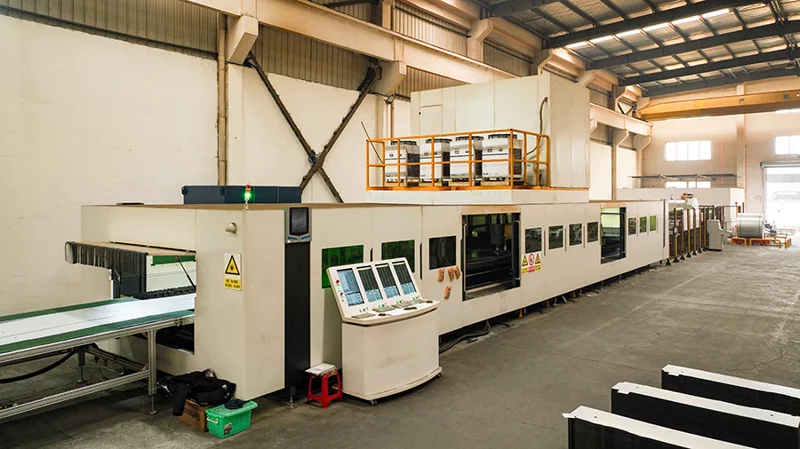
Secondly, flexible nesting saves raw‑material consumption. Rail‑transit components feature diverse and irregular contours. Automatic computer nesting and common‑edge cutting enable compact part layout to improve material utilization, which delivers equivalent efficiency gains by producing more parts from the same coil input.
Regarding cutting speed: laser cutting runs fast for thin and medium‑thickness sheets, achieving comparable speed to mechanical shearing while handling far more complex profiles. Although cutting speed drops for medium‑heavy plates, overall productivity remains competitive thanks to eliminated die‑making procedures.
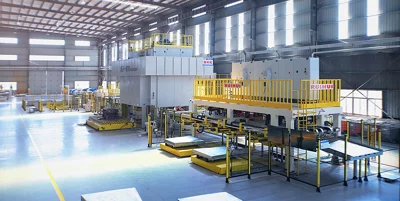
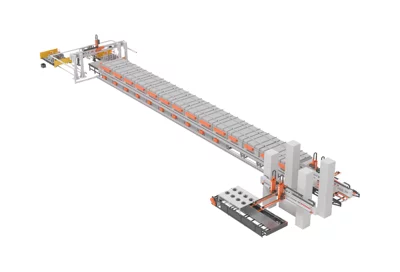
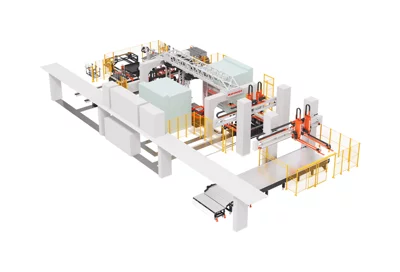
Full‑line automation constitutes another major merit. The integrated workflow covers uncoiling, leveling, feeding, cutting, sorting and stacking. Since rail‑transit sheets are large and heavy, manual loading‑unloading is labor‑intensive. Fully‑automatic material handling speeds up production and improves workplace safety, with operators undertaking only monitoring tasks.
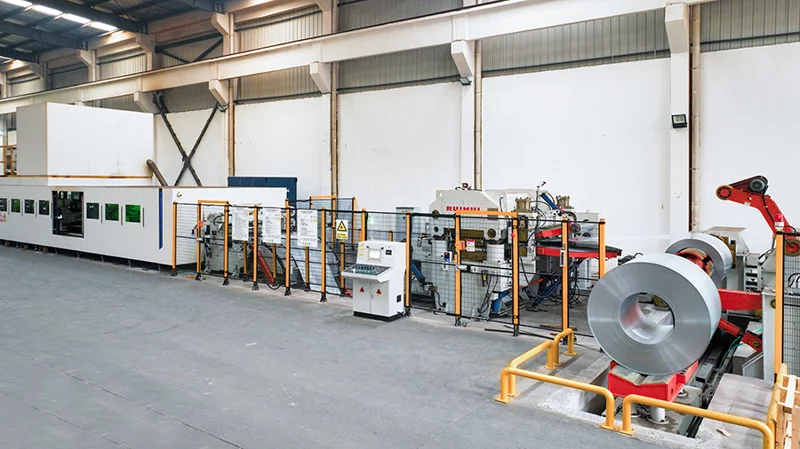
High production flexibility adapts to frequent product upgrades in the rail‑transit sector. Part modification only requires program update instead of new die fabrication, so production lines keep pace with iteration cycles without die‑procurement delays.
Nevertheless, actual efficiency depends on proper equipment configuration. Laser power shall match sheet thickness; insufficient power slows down thick‑plate cutting. High feeding accuracy prevents reject parts, and synchronized takt among feeding, cutting and stacking guarantees real‑world throughput.
In summary, laser blanking lines gain efficiency via shortened change‑over time, material‑saving nesting, full‑process automation and high flexibility. It delivers tangible performance for rail‑transit scenarios with multi‑variant mix, frequent specification switching and large‑size workpieces.
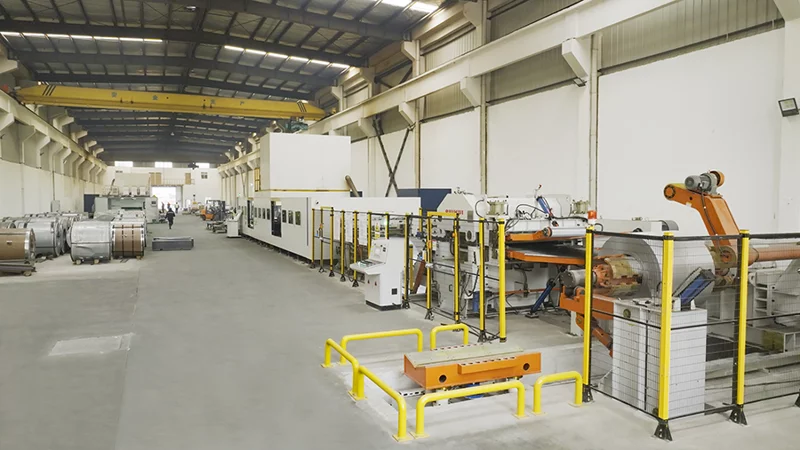
Guangdong Ruihui Intelligent Technology Co., Ltd. has over 20‑year experience in stamping automation and is a national Specialized, Refined, Differential and Innovative “Little Giant” enterprise. Headquartered in Dongguan, it has more than 400 employees including over 80 R&D engineers. Ruihui laser blanking lines are proven for rail‑transit sheet processing. Laser power is configured according to sheet thickness. Automatic nesting and common‑edge cutting boost material utilization. Servo feeding ensures cutting precision, and full‑line automation enables fast program‑based product change‑over with prominent advantages for large‑size sheets. Nearly 5,000 sets of Ruihui‑manufactured equipment operate at domestic and overseas customer sites, serving well‑known OEMs and Tier‑one suppliers such as BYD, Geely, Volkswagen, Tesla, BMW, Mercedes‑Benz, Honda and Jaguar Land Rover, with rich sheet‑processing experience.
With years of hands-on experience, I have honed my skills in navigating the complexities of global commerce, offering invaluable insights and solutions to address customer needs. My commitment to excellence and dedication to customer satisfaction ensure that I deliver exceptional service, guiding clients through every step of the trading process with confidence and proficiency.
You may also like
Related News


Latest Update