

Are Laser Blanking Lines Sufficiently Accurate for Small‑Sized 3C Digital Components
Share to : 


Small metal parts for 3C digital products, such as mobile phone middle frames, shielding covers, heat sinks and connector terminals, feature compact dimensions and strict accuracy requirements. Dimensional tolerance for mobile phone middle frames can be as tight as ±0.05 mm, and shielding covers also demand rigorous contour precision. Whether laser blanking lines can meet accuracy requirements for small 3C parts can be analyzed from multiple dimensions.
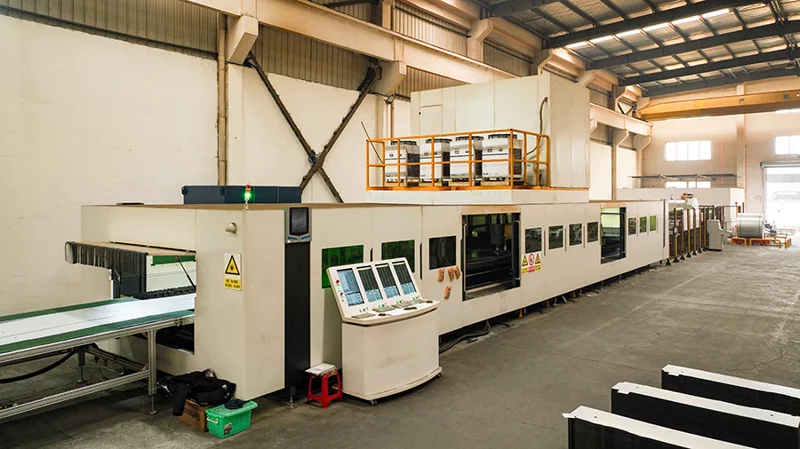
Positioning accuracy and repeat positioning accuracy. Positioning accuracy of a laser blanking line determines whether the cutting head can reach positions specified by programs, while repeat positioning accuracy ensures consistency among individual blanks. Mainstream laser blanking lines achieve positioning accuracy of ±0.05 mm and repeat positioning accuracy of ±0.03 mm, sufficient for most small 3C components. Nevertheless, 3C products iterate rapidly with rising accuracy standards. For high‑end parts with tighter tolerances, verify whether equipment accuracy indexes match product requirements during selection.
Cut‑section quality. Small 3C parts require superior cut surfaces with minimal dross and burrs and low surface roughness. Cut‑section quality depends on laser power, cutting speed, assist‑gas pressure and focal length. Insufficient power causes incomplete penetration; excessive speed results in rough sections; overly low speed enlarges the heat‑affected zone. Premium laser blanking lines store pre‑set cutting parameter groups for different materials and thicknesses for quick recall during product changeover. Certain high‑end models adopt auto‑focus function, enabling the cutting head to adjust focal length automatically against minor undulations on material surfaces for more stable section quality.
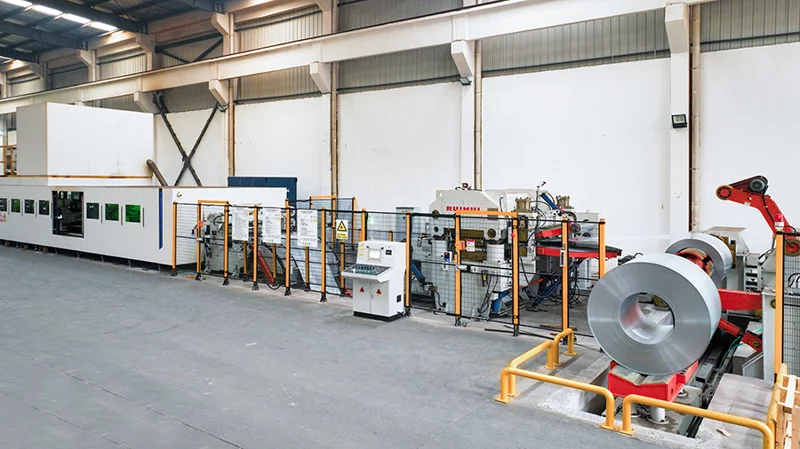
Heat‑affected zone control. Some small 3C components are thin‑walled. Excessively large heat‑affected zones from laser cutting may trigger workpiece deformation or alteration of material properties. Fiber lasers deliver relatively small heat‑affected zones, which can be further minimized with optimized cutting parameters. For ultra‑thin materials, high‑peak‑power short‑pulse cutting can be adopted to reduce heat impact further.
Surface protection. 3C products impose strict appearance standards, so material surfaces must remain scratch‑free during cutting. Conveying and positioning mechanisms of laser blanking lines must avoid scratching sheet surfaces, especially for cosmetic‑grade materials where even tiny scratches cannot be concealed in subsequent processes. Some laser blanking lines equip conveyor belts with soft cushions to prevent scratches on sheet bottoms. Fumes and debris generated in cutting shall be extracted promptly to avoid contaminating sheet surfaces.
Cutting efficiency. Mass volumes are typical for small 3C parts; a single production line may consume millions or even tens of millions of blanks annually. Laser blanking line cutting speed must match the takt time of downstream stamping lines. For commonly‑used 3C materials ranging 0.3‑1.0 mm, fiber lasers realize high cutting speeds. Equipped with multiple simultaneous cutting heads or dynamic follow‑up cutting, the whole‑line throughput satisfies mass‑production demands.
Automatic loading/unloading and stacking. Finished small 3C blanks need neat stacking before delivery to stamping lines for forming. Laser blanking lines fitted with automatic unloading and stacking devices deliver finished blanks via conveyor belts and stack blanks in pre‑defined quantities. Stacking neatness and surface protection shall be guaranteed to prevent collision damage. For magnetizable small 3C parts, magnetic stacking improves surface protection performance.
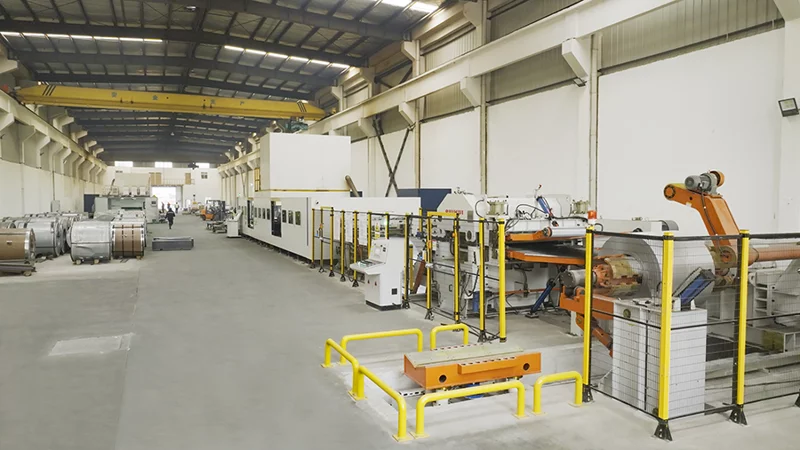
Replacing manual operations with automation brings major improvements in accuracy and consistency for laser blanking of small 3C components. Manual cutting or manual loading/unloading suffers low speed, unstable accuracy and frequent surface scratches. Fully‑automatic laser blanking lines deliver far superior cutting precision and repeatability with uniform dimensions across all blanks. Operators avoid contact with sharp sheet edges for enhanced operational safety. Since no dies are required, new drawings can be imported directly for product changeover, eliminating die‑development time and costs and adapting well to fast iteration cycles of 3C products.
Guangdong Ruihui Intelligent Technology Co., Ltd. has over 20 years of experience in stamping automation and is a national Specialized, Refined, Differentiated and Innovative “Little Giant” enterprise. Headquartered in Dongguan, it has more than 400 employees including over 80 R&D engineers. Ruihui provides dedicated configuration solutions for cutting small‑sized 3C digital components on laser blanking lines. Targeted designs cover cutting‑parameter optimization, heat‑affected‑zone control, surface protection and automatic stacking to satisfy accuracy and surface‑quality requirements of small 3C parts. Nearly 5,000 sets of Ruihui‑manufactured equipment operate at customer sites worldwide, serving well‑known OEMs and Tier‑one suppliers including BYD, Geely, Volkswagen, Tesla, BMW, Mercedes‑Benz, Honda and Jaguar Land Rover.
With years of hands-on experience, I have honed my skills in navigating the complexities of global commerce, offering invaluable insights and solutions to address customer needs. My commitment to excellence and dedication to customer satisfaction ensure that I deliver exceptional service, guiding clients through every step of the trading process with confidence and proficiency.
Related Topics:
laser blanking lineYou may also like
Related News

Latest Update